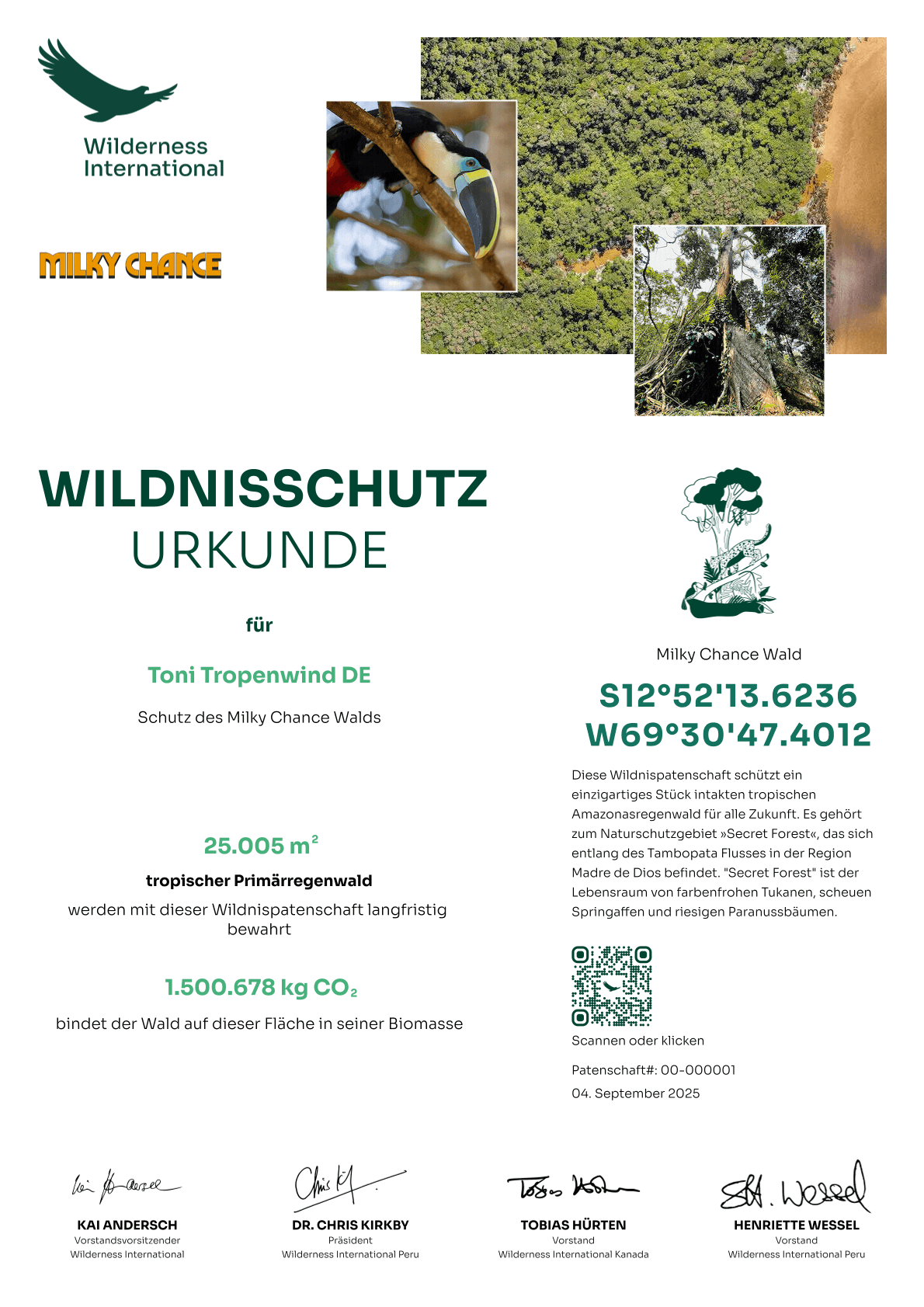
The preservation of the world wilderness in the wilderness . By this we mean that by preserving the wilderness , we preserve the very foundation wilderness own wilderness . Here are the details:
Unique and species-rich nature
The tropical rainforest of the Madre de Dios region is a unique ecosystem; its primeval forests are home to the world’s greatest biodiversity. Mysterious jaguars and playful monkeys are just as much at home here as clumsy tapirs and liana-draped giant trees. There are ten times more reptiles and amphibians here than in Germany; approximately 10% of all the world’s bird species can be observed here; and in a single hectare of forest, you can find more tree species than in all of Europe—to name just a few examples. Additionally, the region is home to endemic animal and plant species that have adapted so strongly to the local ecosystem that they can survive only there. To date, Secret Forest in Peru bird species, 162 amphibian and reptile species, and 92 mammal species (including 48 large mammal species and 44 bat species) have been recorded in Secret Forest in Peru . By comparison, only 21 amphibian species, 15 reptile species, and 25 bat species live in Germany.
Canada’s temperate rainforest is no less spectacular. These primeval forests, too, are home to a unique biodiversity, giant trees thousands of years old, and beautiful raised bogs, whose underground biomass stores up to three times as much carbon as the forests of British Columbia. Rare ghost orchids are at home here, along with bears, wolves, and eagles. The older forests become, the greater their genetic diversity and the better the reproductive capacity of their inhabitants. Thus, primeval forests guarantee the survival of countless species and are essential for the preservation of biodiversity (Gibson et al., 2011). Only if existing, intact ecosystems are preserved can rare or endangered species spread out from there again.
This is an essential prerequisite for the restoration and rehabilitation of damaged forests, land, and soils—especially those affected by desertification, drought, and flooding. Some functional groups, such as fungi, lichens, and beetles, take up to 180 years to recover after their habitat has been cleared, yet they never return to the levels they had before the destruction. These slow recovery rates of certain functional groups—which are essential to ecosystem functioning—make primary forests an irreplaceable resource for biodiversity (Spake et al., 2015). Germany, too, was once covered with primeval forests of old-growth trees. The fact that nothing remains of them today shows that wilderness be taken for granted. It is our responsibility to protect the remaining wilderness areas, no matter where they are located.
Climate Conservation
The rainforest plays a major role in the greenhouse effect—the warming of the atmosphere—in several ways. First, large amounts of CO₂ are sequestered in the rainforest’s biomass—and the temperate rainforests of western Canada are global leaders in this regard. Nowhere else do trees and forest bogs sequester as much CO₂—over 60 kg per square meter in the Misty Forest! In addition, trees with large diameters store extremely large amounts of carbon (Mildrexler et al., 2020). If the forest is logged or cleared by fire, massive amounts of CO₂ are released. Estimates suggest that about 10 to 15% of annual CO₂ emissions are attributable to slash-and-burn practices (Wille, 2018). By protecting these forests, we ensure that carbon remains sequestered and does not return to the atmosphere as CO₂, where it would accelerate global warming. Greenhouse gases are distributed evenly throughout the atmosphere—it is therefore irrelevant where emissions are generated or avoided. What matters most is that the global concentration of greenhouse gases in the atmosphere is reduced.
Rainforests are also of paramount importance to the climate because they help balance temperature differences and regulate global rainfall patterns. Without the cooling and water-storage functions of rainforests, vital rainfall would be lost, leading to increasingly hot and dry conditions. Furthermore, forests produce vital oxygen and filter the air.
Protecting the rainforests of Peru and Canada thus makes a tangible contribution to stabilizing the climate. Learn more about this here.
Acute threat
The scientific community describes the effects of rainforest destruction as the greatest natural disaster since the last ice age. 2024 was a dismal record year for forest loss. In a single year, tropical forests were lost at a record rate of 6.7 million hectares—an area equivalent to the size of Panama (WRI, 2025). Most of this destruction was caused by human-induced fires, which are often used to clear land for livestock grazing or agriculture. The ongoing loss of forest has catastrophic effects on biodiversity. The extinction of a single plant species is often linked to the extinction of another 10 to 30 animal and plant species, as most organisms in the rainforest are interdependent (Siebert, 2011). Millions of species have thus disappeared along with the forest in recent decades.
Yet while almost everyone is aware of the threats facing the Amazon rainforest and its value, hardly anyone speaks of Canada’s forgotten ecosystem: British Columbia (BC) is home to the world’s last large contiguous area of temperate rainforest (DellaSala, 2010). old-growth forest still exists there. And yet, unfortunately, the timber industry in Canada is one of the most important economic sectors, and BC, of all places, is one of the last jurisdictions on Earth that continues to allow the large-scale logging of 600- to 1,800-year-old primeval forest giants (Wu, 2019). Between 2003 and 2010, deforestation in BC alone was responsible for annual CO₂ emissions of 49.5 megatons (Wieting, 2015), more than the entire country of Finland. Only about 25% of the original area of temperate rainforest remains in Canada. In addition to the threat posed by the timber industry, these remaining areas are also threatened by the creation of new agricultural land, urban sprawl, and the construction of new infrastructure, as well as Canada’s withdrawal from the Kyoto Protocol.
The threat to the regions where our protected areas are located—and thus the importance and additional value of our project—has also been confirmed by the independent expert opinion prepared by Rainer Kant of BAUM e.V.
Saying thank you to nature
The natural balance is only maintained if we no longer just take, but also give. Therefore, it is time to finally give back to nature. Let's say thank you for everything she provides us with - let's protect her.